
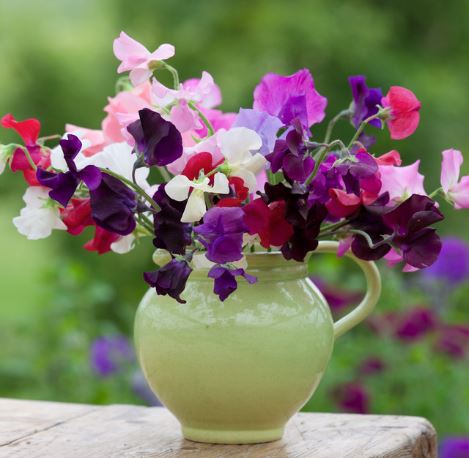
WeWeed’s horticulturalist John Brannan shares his expert knowledge on growing sweet peas in a three part tutorial!
Part 1: Sowing the Seeds!
 There are 5 ways to grow sweet peas, as far as I know, and each method has its own merits and pitfalls.
Before I discuss method, we need to decide which varieties to choose and there are a wide range of forms and colours to choose from. Traditionally we would spend the Christmas and new year holidays browsing the seed catalogues and dreaming about next year’s crops, flowers, fruit or veg?
But the time is now, so we need to get a wriggle on if we don’t want to miss the boat this time.
Luckily for me, my previous homework can be revisited and my choices suit me and those that I need to satisfy.
The delicious and historic cupani is an absolute must have as a starting point and from there the choice is down to personal taste, but my basic advice is to choose varieties that you like the colour of and that have fragrance.
The four basic methods are;
Autumn sowing while some advocate this method and the advantage should be that you have earlier and bigger crops, its fraught with difficulties overwintering plants that can get too leggy and don’t like the transplant shock. If spring is late, it can be labour in vain and did I mention mice? They love to feast on sweet young stems and seeds.
Spring sowing is to be preferred in my book. None of the overwinter problems and if we are lucky, unchecked growth from seed to plot to harvest.
Open ground sowing. In theory and in perfect conditions, this is how nature intended and should work, but this approach is beset with every problem one really doesn’t need, so we won’t go there.
Cuttings. I tried this a few years ago and it works really well if you have a growing crop of seedlings, it’s a great way to increase the number of plants you get.
Method
We need seed, compost ,containers and protection for our seedlings
Seed. Choose the varieties you would like from well established seed houses. Buy online as the seed will have been kept in optimal conditions, Garden centre seed will have been kept in sub optimal conditions in a warm garden centre showroom. As a rule buy fresh seed every year as it has a much better germination capability. All the top seed suppliers will test their seed for germination capability , so it should come with guarantee,
Compost. carefully choose a compost formulated for seed sowing and try to avoid a general purpose compost as it wont have the correct nutrients
I personally avoid anything with green waste recycled compost and go with composted wood based products and I also tend to avoid coir based as they are not very green ( in my opinion ) due to the compost miles nor are a particularly good medium for seed sowing. Sharp sand , perlite , vermiculite and other media are also perfectly good to aid seed germination, provided all other limiting factors are catered for. But for now, keep it simple!
Containers. Old yoghurt pots? Old toilet rolls? As they say, you get what you pay for.
In a past life , I was seed treatments manager for one of europes biggest forestry seed companies and have worked with some of the biggest forest seedling producers and seedling quality is of paramount importance to both the seedling producer and for the successful establishment of those seedlings in situ with the obvious benefits to all concerned.
Accordingly, I use and recommend rootrainer cells, they are designed to specifically to direct the emerging roots from a seed to grow downwards and branch out without root girdling in a smooth sided round pot. The opening book concept of these cells is unique and helps to minimise root disturbance that many species resent in the transplanting process. Rootrainers are ideally suited to growing sweetpea seedlings
Old yoghurt pots? Well ok they serve a purpose in some contexts. They need drainage holes so the seedlings don’t drown or rot
Old toilet rolls fine as long as they bio degradable and a step up from the yoghurt pot.
My picture shows how we half fill the rootrainer cells, tamp down the compost with a stick then thoroughly water the half- filled cell with tap water via a fine rose.

We then fill the cell with our compost, and insert the seed 10mm below the surface, cover with compost and place a sheet of old newspaper over the top. 12-16 celcius is fine for germination.
DO NOT PRE SOAK THE SEED They are very sensitive to excess moisture
DO NOT WATER again until the seedling has emerged, as they are very susceptible to rotting from over watering.
WATER FROM BELOW as and when required, as watering from above gives a cold water shock that will lead to trouble!
While we wait for the cold weather to pass, we can cultivate the ground to plant our seedlings into and when we have warmer take cuttings to bulk up our crop. We all look forward to warmer weather and I hope this missive will give encouragement to our collective?
Part 2 coming in April!
Need to ask John some questions? Send him a message via his profile!